Posts

Proofs of Logarithm Properties

$log_aM +  log_aN = log_aMN$  (1) proof:  assume: $log_aM = m, log_aN = n$  so:  $a^m = M, a^n = N \Rightarrow M \cdot N = a^m \cdot a^n = a^{m+n}$  $log_a{MN} = m + n = log_aM + log_aN$  $log_aM - log_aN = log_a\frac{M}{N}$ (2) proof: assume: $log_aM = m, log_aN = n$ so: $a^m = M, a^n = N \Rightarrow \frac{M}{N}=\frac{a^m}{a^n} = a^{m - n} \Rightarrow log_a{\frac{M}{N}} = m - n = log_aM - log_aN$ $log_aa^M = M$ (3) proof: assume: $a^M = B \Rightarrow log_aB = M$ so: $log_aa^M = M$ $a^{log_aM} = M$ (4) proof: assume: $log_aM = B$ so: $a^B = M$ $\because B = log_aM, a^B = M$ $\therefore a^B = a^{log_aM} = M$ $log_aM^N = Nlog_aM$ (5) proof: $log_aM^N = log_a(\overbrace{M \cdot M \cdots M}^{N})$ $\because log_aM +  log_aN = log_aMN$  property (1) $\therefore log_a(\overbrace{M \cdot M \cdots M}^{N}) = \overbrace{log_aM + log_aM + \cdots log_aM}^{N} = Nlog_aM$ $log_ab = \frac{log_cb}{log_ca}= \frac{lnb}{lna} = \frac{lgb}{lga}$ (6) ...
Formula for Arithmetic Series

The Simple Arithmetic Sequences Let's say we have the simplest of arithmetic sequences. $\{1, 2, 3, \cdot\cdot\cdot, n\}$ And what I want to think about is what is the sum of this sequence going to be? And the sum of a sequence, we already know we call a series as following: $S_n = 1 + 2 + 3 + \cdot\cdot\cdot + n$ $S_n = n + (n-1) + (n-2) + \cdot\cdot\cdot + 1$ Now I'm going to add these two equations. $2S_n = (n+1) + (n+1) + (n+1) + \cdot\cdot\cdot + (n+1)$ So how many of these $(n+1)$ do we have? Well we have n of them there were n of these terms in each of these equations. So, we can rewrite this thing as following: $2S_n = n(n+1)$ $$ S_n = \frac{n(n+1)}{2} = n \cdot \frac{n+1}{2} = n \cdot \frac{a_n+a_1}{2} $$ $a_n$ is the nth term in our sequence, $a_1$ is the first term in our sequence. General Arithmetic Sequences Let's write an arithmetic sequence in general terms. $\{a, a+d, a+2d,\cdot\cdot\cdot, a+(n-1)d\}$ d  could be a positive or a negative number, which we cal...

Argument Passing by Value or Reference

#include // To read from the standard input, we write std::cin. These names use the // scope operatro(::), which says that the compiler should look in the scop // of the left-hand operand for the name of the right-hand operand. Thus, // std::cin says that we want to use the name string from the namespace std. // Referring to library names with this notation can be cumbersome. // Fortunately, there are easier ways to use namespace members. The safest // way is a **using declaration.** // A using declaration lets us use a name from a namespace without // qualifying the name with a namespace_name::prefix. A using declaration // has the form // using namespace::name: // Once the using declaration has been made, we can access name directly: // #include // uisng std::cin; // int main() // { // int i; // cin >> i; // ok: cin is a synonym for std::cin // cout using std::string; // Passing arguments by value void reset_passed_by_value(int *ip) { *ip = 0; // ch...

Finite Geometric Series Formula

We know that: a = first term r = common ratio n = number of terms We'r going to use a notation $S_n$ to denote the sum of first n terms as following: $S_n$= sum of first n terms $S_n=a+ar+ar^2+\cdot\cdot\cdot+ar^{n-1}$ We want to come up with a nice clean formula for evaluating this and we're gonna use a little trick to do it. Let's just multiple negative r on both sides of equation as following: $-rS_n=-ar-ar^2-\cdot\cdot\cdot-ar^{n-1}-ar^n$ So: $S_n-rS_n=a-ar^n$ $S_n(1-r)=a(1-r^n)$ $S_n=\frac{a(1-r^n)}{1-r}$

Quadratic Formula

Quadratic Formula: The quadratic equation is as follows: $ax^2+bx+c=0$ The quadratic formula tells us that the solutions to this equation is  $x = \frac{-b\pm\sqrt{b^2-4ac}}{2a}$ So let's apply it to some problem. Let's start off with something that we could have factored just to verify that it's giving us the same answer. Example 1: $x^2+4x-21=0$ $a=1, b=4, c=-21$ $x = \frac{-4\pm\sqrt{4^2-4\cdot1\cdot(-21)}}{2\cdot1}$ $x=\frac{-4\pm\sqrt{16+84}}{2}$ $x=\frac{-4\pm\sqrt{100}}{2}$ $x=\frac{-4\pm10}{2}$ $x=-2\pm5$ So: $x=3$ or $x=-7$ Sothe quadratic formula seems to have given us an answer for this. You can verify just by substituting back in that these do work. $(x+7)\cdot(x-3)=0$ $x+7=0$ or $x-3=0$ $x=-7$ or $x=3$ Example 2:(no real solutions) $3x^2+6x+10=0$ $a=3, b=6, c=10$ $x=\frac{-6\pm\sqrt{6^2-4\cdot3\cdot10}}{2\cdot3}$ $x=\frac{-6\pm\sqrt{36-120}}{6}$ $x=\frac{-6\pm\sqrt{-84}}{6}$ It jus gives us a square root of a negative number. It means this will have no real sol...

FreeBSD安装fcitx中文输入法(csh/tcsh)

Install # pkg install zh-fcitx  # pkg install zh-fcitx-libpinyin # pkg install zh-fcitx-table-extra # pkg install zh-CJKUnifonts Configurations 1. 文件 ~/.cshrc 添加的內容如下: setenv XMODIFIERS @im=fcitx 2.文件 ~/.xinitrc 內容如下: exec fcitx -d & . /usr/local/etc/xdg/xfce4/xinitrc

Red-Black Trees

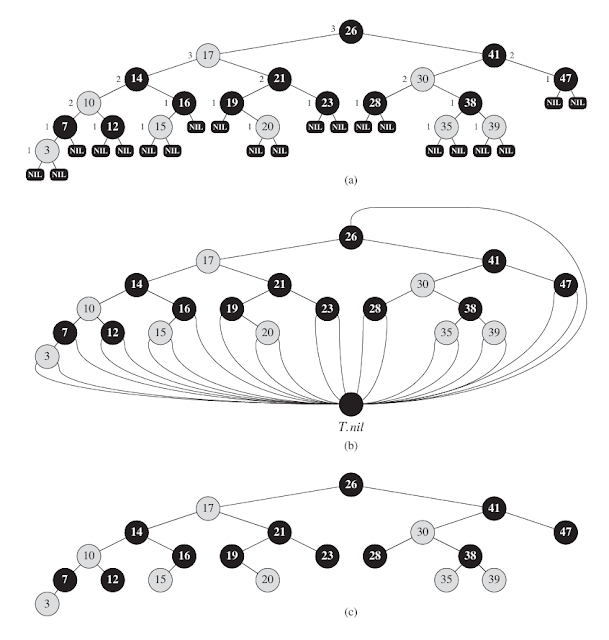
Image
Binary Search Trees showed that a binary search tree of height h can support any of the basic dynamic-set operations—such as SEARCH, PREDECESSOR, SUCCESSOR, MINIMUM, MAXIMUM, INSERT, and DELETE—in O(h) time. Thus, the set operations are fast if the height of the search tree is small. If its height is large, however, the set operations may run no faster than with a linked list. Red-black trees are one of many search-tree schemes that are “balanced” in order to guarantee that basic dynamic-set operations take O($log_2n$) time in the worst case. Properties of red-black trees A red-black tree is a binary search tree with one extra bit of storage per node; its color , which can be either RED or BLACK. By constraining the node colors on any simple path from the root to a leaf, red-black trees ensure that no such path is more than twice as long as any other, so that the tree is approximately balanced . Each node of the tree now contains the attribute color , key , left , right , and p . I...